The terms ‘private market investments’ and ‘alternative investments’ are often used interchangeably. But although private assets and alternatives do have plenty of overlap, they are actually distinct concepts. That confusion matters, since each category of investments can play a different role in a portfolio.
In this article, we’ll define each term and look at how investors can categorise assets along two distinct spectrums. Both private assets and alternatives have long been popular investment tools among the ultra-wealthy. As these tools become more widely accessible, appreciating their differences can help investors understand the potential risks and rewards they introduce.
Key Takeaways:
- Private investments are any assets that cannot be accessed through public markets. Alternative investments are any asset classes outside of traditional equity, credit, and cash.
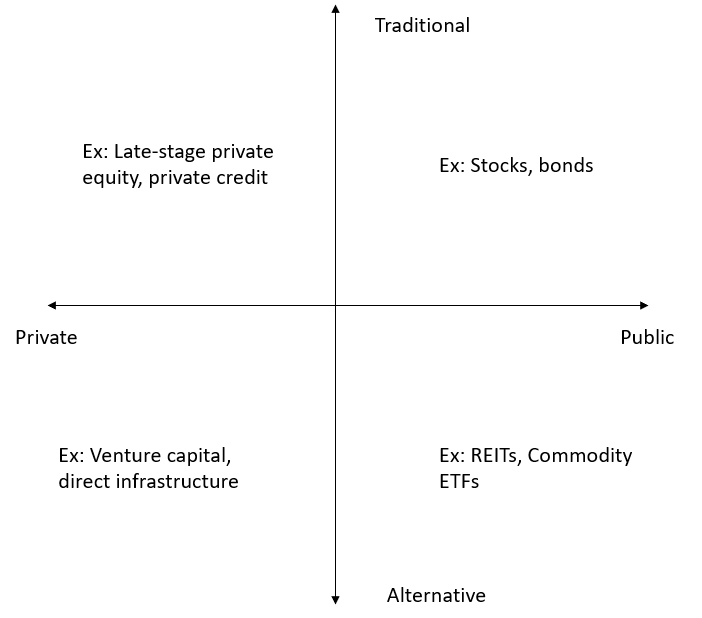
- Investors can view assets along two distinct spectrums: public-private and traditional-alternative. Investment categories include public alternative, private traditional, or other combinations.
- Private assets and alternatives tend to have a strong overlap. Due to differences in liquidity, standardisation, and regulation, many alternative assets are more effectively accessed via private markets.
- The distinction between private assets and alternatives matters, since each category can potentially help investors achieve different goals. Depending on where an asset falls on each spectrum, it may be better suited for goals like diversification, yield, or returns.
It’s important to note that the content of this article is based on current public information which we consider to be reliable and accurate. It represents Sidekick’s view only and does not represent investment advice - investors should not take decisions to trade based on this information.
Investing puts your capital at risk. The value of investments can go down as well as up, and you may get back less than you put in. Private market assets are high-risk investments that may be illiquid and long term in nature. These are high-risk investments, available to eligible sophisticated and high-net-worth investors only. You could lose all of the money you invest.
Defining the terms: Private assets and alternatives
As we’ll see, private assets and alternatives tend to have strong overlap in practice. But that doesn’t mean they’re identical. Properly defined, here’s what each term means:
- Private assets – Private assets are investments that cannot be accessed via public markets. Private market assets don’t trade on an exchange, typically have relatively low liquidity, and often come with regulatory restrictions as to who is allowed to purchase them.
- Alternative investments – Alternative investments are any asset classes outside the traditional world of stocks, bonds, and cash. Examples of alternatives can include real estate, infrastructure, raw land, commodities, or digital assets.
This taxonomy provides greater clarity when discussing potential investments within a portfolio. For example, there can be public alternatives, such as an exchange-listed real estate fund. Conversely, there can be private assets that fall far closer to traditional investments, such as private shares in a mature, late-stage company.
In the real world, the distinction isn’t always so clear-cut. Private credit loans made to large firms carry many of the same characteristics as traditional bond investing, but private credit loans made to tech startups might properly be considered an alternative. As a result, the private-public and traditional-alternative distinction should be viewed as two spectrums along which assets can fall.
Private assets and alternatives: Why the overlap?
It’s no coincidence that private assets and alternatives are so often confused. Many alternative investments can be more effectively accessed via private markets than public markets. That’s due to some of the fundamental differences between alternative assets and traditional assets:
- Liquidity – Many alternative assets can be hard to sell in a timely manner. As an example, consider an infrastructure investment fund trying to offload a large power plant. The inherent illiquidity of many alternatives can be a poor fit for the daily trading of public markets.
- Customisation – Traditional public assets tend to be highly standardised investments. One share of stock in a public company is essentially the same as any other, which makes exchange trading possible. In contrast, alternatives have a wider scope for customisation, which can be a better fit for the bespoke negotiations of private markets.
- Regulation – Alternative managers can sometimes employ advanced investment strategies, such as the use of short selling or leverage. Funds offered to public market investors may not be allowed to use such strategies.
These factors help explain why the overlap between alternative assets and private markets is so strong. Still, the two categories are not one and the same. Exchange-listed venture capital trusts in the UK are one example of alternative investing through public channels.
Private assets vs. alternatives: Why it matters
The distinction between private assets and alternatives might seem needlessly nuanced. Does understanding the difference between these investment concepts really matter?
The answer is yes, and not just for reasons of precision. Both private market assets and alternative investments can potentially offer benefits to a well-diversified portfolio. However, each category may be better suited to help investors achieve distinct goals.
For example, investors seeking greater diversification may not be satisfied with traditional private market investments. While asset classes like private equity and private credit do offer some diversification benefits, they tend to have a stronger correlation to public stocks and bonds than many alternatives.

Data Source: JPMorgan Guide to Alternatives 3Q 2025
In contrast, some investors may be seeking higher returns or higher income, but are not comfortable with wading into unfamiliar asset classes. For these individuals, private equity and private credit may end up being a better fit. These asset classes come with risk factors that are closer to traditional public market investing, but with a stronger track record of historical performance.
Past performance is no guarantee of future returns, and the goals that alternatives and private assets can help achieve may evolve over time. However, viewing these two categories as distinct offers greater insight into the role that each can play within a diversified portfolio.
Conclusion: Complementary, not competitive
While private assets and alternatives are not identical, neither should they be viewed as competing tools. Depending on an investor’s unique goals and risk tolerance, their portfolio may comprise assets that span all four quadrants of the investment universe. Precise terminology can offer greater clarity about the risk factors and potential rewards that each investment introduces into a portfolio.
Both private markets and alternatives have long been the sole domain of the ultra-wealthy. But as everyday investors increasingly gain access to these assets, they can access a wider toolkit to help achieve portfolio goals, whether that be diversification, higher yields, or inflation protection. The key is knowing which tool to reach for – which starts with understanding what makes each one different.
It’s important to note that the content of this article is based on current public information which we consider to be reliable and accurate. It represents Sidekick’s view only and does not represent investment advice - investors should not take decisions to trade based on this information. Private market assets are high-risk investments that may be illiquid and long term in nature. These are high-risk investments, available to eligible sophisticated and high-net-worth investors only. You could lose all of the money you invest.
Notices
Investing puts your capital at risk. The value of investments can go down as well as up, and you may get back less than you put in. Sidekick’s Private Markets products are only available to individuals in the UK who self-certify as either High Net Worth or Sophisticated Investors. These are high-risk investments that may be illiquid and long term in nature. You could lose all of the money you invest. If you're unsure whether an investment is right for you, it’s best to speak to a qualified financial adviser.
The information in this email is not investment advice or a personal recommendation. We do our best to ensure it is accurate and up to date, but we can’t guarantee this at all times. Tax treatment depends on your personal circumstances and may change in the future. This message is confidential and intended only for the recipient. If you’ve received it in error, please let us know and delete it.
Sidekick Money Ltd is a company registered in England and Wales (No. 13882980). Sidekick Money Ltd is authorised and regulated by the Financial Conduct Authority (FRN 984829). Our address is 6-7 St Cross Street, London, EC1N 8UB.
Get set up quickly

Your new way to wealth starts here
Modern tools. Human expertise. More control.